The Locking Life

Thought I would do a post about locking since it is something most people are unfamiliar with and we get a lot of questions about it…

The locks allow canals to traverse varied terrain in a controlled manner.  The canals connect various river valleys (i.e. the Canal du Burgogne connects the Seine with the Saone) passing over the intervening hills. The locks allow boats to climb mountains!

Each lock consists of two sets of doors and two sets of gates, usually part of the doors,. The doors allow the boats to pass, the gates allow the water to pass. To ascend a lock, with both sets of doors closed and the lock full, the lockeeper will open the lower gate allowing the water to flow out of the lock. When the water in the lock has reached the lower canal level, the lower doors are opened allowing a boat to enter the lock. The lower doors and gates are then closed and the upper gates opened, allowing water to flow back into the lock from the upper canal. When the lock level reaches the upper canal water level the upper doors are opened allowing the boat to exit. The process is repeated in the opposite direction to descend.

Some of the locks are completely manual, with the lock keeper (with sometimes help from a boat crew member) cranking open the doors and gates. Some of the locks have hydraulics to open the doors and the gates are manual. Some have manual doors and hydraulic gates and yet others are fully hydraulic with the lock keeper standing at a control panel. And yet others are completely automatic with no lock keeper present, relying on the boat operators to initiate the lock cycle (usually with a pull cord located outside the lock to request access and another pull cord inside the lock to begin the cycle). You really never know when approaching a lock what you will find.

A lock cycle can take anywhere from 5 minutes to 20 minutes (or sometimes much longer if there is a line of boats waiting or you have a particularly loquacious lock keeper).

A word about the size of the locks  in Burgundy. They vary in length in the canals, from 30m long in Lock #15 on the Canal du Nivernais up to 40m on the Canal de Roanne, but most are a “standard” 38.5m (126 ft). The widths are all about 5m (16.4 ft).  Our boat is 11.6 meters by 3.8 meters. We have been in locks where the lock keeper squeezed in three boats our size – 35 m of boats in a 38 m lock!    The picture shows our boat to scale in a standard lock.

Screen Shot 2017-07-28 at 3.53.30 PM

In the rivers the locks are much bigger because there is still significant commercial traffic. The biggest lock we have been in was the Seine Varenne lock, 220m long by 17m wide. The second figure above shows a to-scale plan of the Seine Varenne lock and our boat.

The depth of the locks (how much the boat rises or lowers) various dramatically. We have been in the 10.7 meter (35 feet) Canal du Centre lock off the Saône and in a 0.48 meter (1.5 feet) lock in the Canal du Nivernais but they are typically 2-4 meters. In the deeper locks, going up, the lock keeper usually lowers a hook to take your line to attach it to a bollard on the surface. Some of the deep locks have floating bollards that go up with the boat.

Locks are really very simple and quite safe. The only really bad thing you can do is tie off your line to the boat (rather than holding it loosely). When locking down, if the line is cleated, the boat will “hang” as the water level drops. I’ve seen this happen and it is quite scary. The boat ends up hanging off the line until either the line is cut, breaks or the cleat pulls out of the boat. The boat then drops the 5-10 feet to the water. Once the boat starts to hang, the line cannot be released, it has to be cut. Most of the regular cruisers carry knives for this purpose or have one very handy.

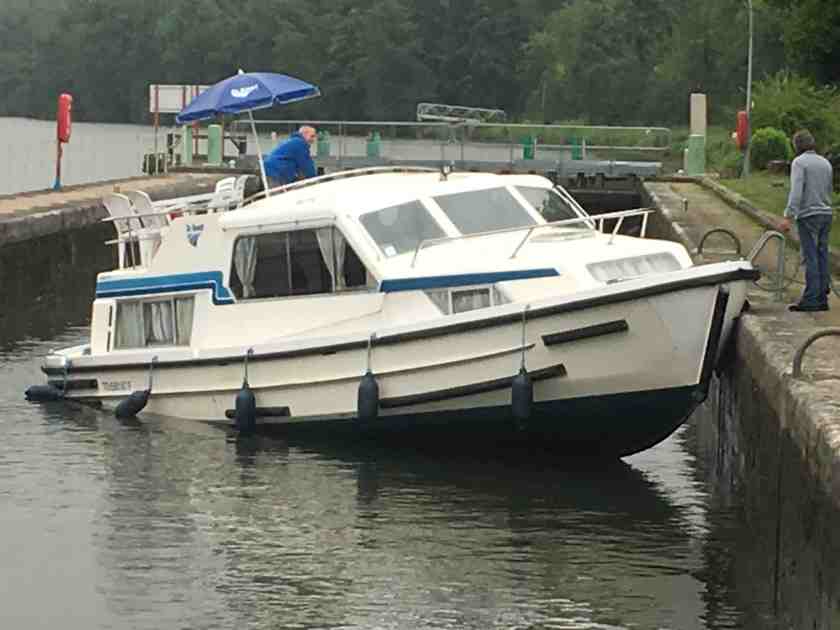
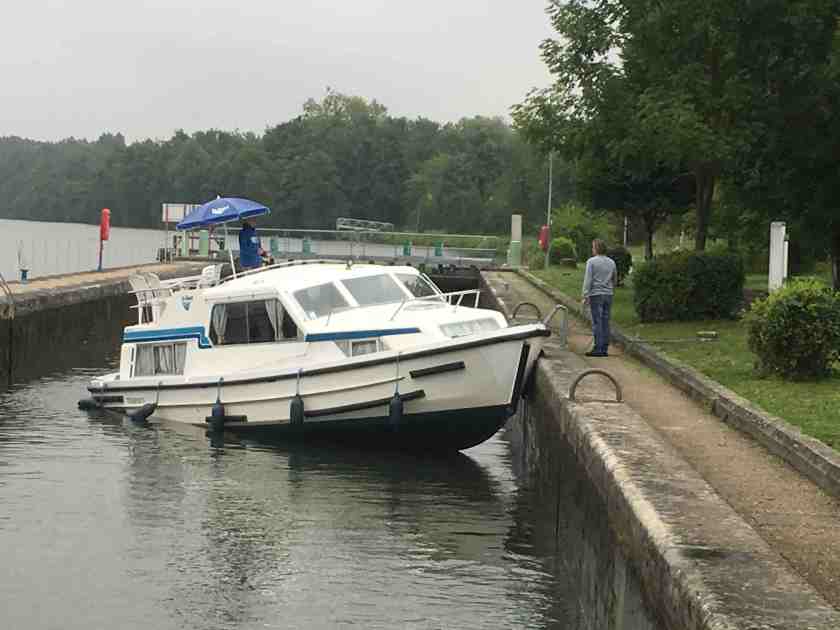
Here is a sequence of a boat locking up (ascending from a lower canal level to a higher canal level):

Lower doors open, boat enters lock.


Lower doors closing behind boat(s)


Upper gates open, lock filling.


Up lock doors open, boat exits lock at the higher level.

And here is a sequence for locking down. Note that this is an “automatic” lock – there is no lock keeper.

Approaching automatic lock, cord (~100m from lock entrance) is pulled.


Doors open and boat enters lock

Crew jumps off boat, after securing line, pulls the lock initiation cord.


Upper doors close behind the boat(s).


Lower gates open, lock empties to lower canal level.


Lower doors open, boat(s) exit lock.

Emerson, Linda and the Pont-canal

We passed over one of the three large canal bridges over the Loire river – this one on the western terminus of the Lateral Canal à la Loire.  It is very strange to be boating in the air, 60 feet over a large river.

And we had our first Martini Night with Emerson and Linda. We were joined by a captain from a neighboring boat who was clearly enamored with the USA and ended up presenting us with the a coveted VNF flag (we’ve been looking for one for weeks).

Napoleon, Montereau and Moret-sur-Loing

We left Montereau, the site of Napoleon’s last big victory against the allied Austrian forces in the catchily named “War of the Sixth Coalition.” (Theyhad a heck of time, but this was the war that eventually ended with Napoleon in exile on Elba. Of course he later escaped – which resulted in the “War of the Seventh Coalition,’ but that’s another story). They have a big statue of Napoleon on the bridge with the famous quote “Don’t worry my friends, the cannon ball that can kill be has not yet been made!”

Another battle in the war occurred the day before at Moret-Sur-Loing (where we are currently) as the French attempted to delay the advancing coalition forces. A cannon ball remains in one of the medieval doors into the city.

Moret 2 - jun 16
A couple of tourists below a wayward Prussian cannonball in the Porte de Samois.

We arrived here yesterday (it was highly recommended by a cruising couple we met a few weeks ago) and plan to lay over a day. This will also give us a chance to defrost our freezer which is a major project, before we start south on a new canal, Canal du Loing.

Moret 6 - Loing Jul 16
Sunday fun on a hot day in Moret-Sur-Loing

Turns out the Loing is not always a gentle as we see it today. Talking to the harbor master, she said it flooded last June and completely destroyed the office and marina which has since been rebuilt.

Moret 3 Flood Gauge
Flood gauge o the Loing, note the June 2016 mark!

Moret is a lovely medieval town with a 12th century church (though, to be honest, pretty much every town has an incredible medieval church or two) and still has two of the original town wall gateways.

But clearly everyone is not excited about our arrival……

Swimming with the big fish…. and the Seine!

On  a long day of motoring (we did not moor until 7 pm and hit the last last lock at closing time – 6:30 pm) we finished the Yonne portion of our adventure. The locks in the upper Yonne are huge and with quite a bit of commercial traffic.  The big barges completely fill the locks so you have to wait if one is ahead. To put this in perspective, 20-30 boats our size could easily fit in one of the locks.

Big Boys 1 Jun 15
Waiting on a big boy to pass so we can enter the lock

The commercial barges seem to act like independent truckers – they have living quarters (some even have cars on the back deck they can load and unload with the onboard crane). Interesting life!

The Yonne is lovely and we were completely alone for many hours yesterday. Unlike the Saône, however, there are few “nature” mooring opportunities and ones we saw were occupied by fisherfolk (after biking, fishing must be the most popular activity in France!) so you are restricted to mooring in towns. But they can be quite nice – our mooring in Montereau (where the Yonne joins the Seine) is just across from a great 12th century church.

Montereau Jun 15
From our mooring, Notre Dame et Saint Loup

And we can see the Seine from here! The traffic promises to be even more interesting (i.e. bigger barges) but we are only in it for 12 Km or so before turning south on the Canal du Loing.

Seine Jun 15
The Seine (just past the bridge)  from our mooring (in the Yonne).

Frencheries

One thing we’ve noticed in the two months we’ve been here is how the French like to take a thing and add “erie” to describe the maker or seller of the thing. For instance, boulanger is the verb to bake, and boulangerie is the baker or bread shop. Some are not even French words (jeannerie, gadgeterie, etc.) Here is my, as yet incomplete list, of  “Frencheries”.

  • Animalerie:  Pet Store
  • Billetterie: Ticket seller (Billet = ticket)
  • Boucherie: Meat Seller (Boucher = butcher)
  • Boulangerie: Bakery (Boulange = baker)
  • Bagagerie: Baggage seller.
  • Briquetterie: Brick Maker
  • Carterie: Card shop
  • Coifferie: Hair Salon?
  • Capitainerie: Harbor Masters Office
  • Cordonnerie: Shoe Maker/Repair
  • Cremerie: Creamery
  • Droguerie: Hardware/drugstore
  • Gadgeterie: Electronics (this is one of my favorites!)
  • Horlogerie: Clock repair/sales
  • Bijouterie: Jewelry store (Bijou = jewelry)
  • Imprimerie: Printer
  • Jeannerie: Jeans store (another favorite!)
  • Juiverie: Jewish quarter
  • Literie: Bedding (Lit = to sleep)
  • Maroquinerie: Leather goods (purses/belts)

Jeannerie

  • Metallerie: Metal working
  • Ferronnerie: Iron Works
  • Mercerie: Hat shop ??
  • Onglerie: Manicurist (Ongle: Nail)
  • Papeterie: Stationery Store

Ferronnerie - Metallerie

  • Pataterie; Potato seller??
  • Poissonnerie: Fish Monger (Poisson = fish)
  • Quincaillerie: Hardware store
  • Retoucherie: Alterations Place
  • Saladerie: Salad place
  • Tannerie:  Tannery
  • Tapisserie: Tapestry maker
  • Teinturerie: Dyer/Dry Cleaner
  • Tresorerie: Treasury
  • Menuiserie: Carpentry Place


Eastern Loop ….. DONE!

Screen Shot 2017-04-12 at 4.30.40 PM
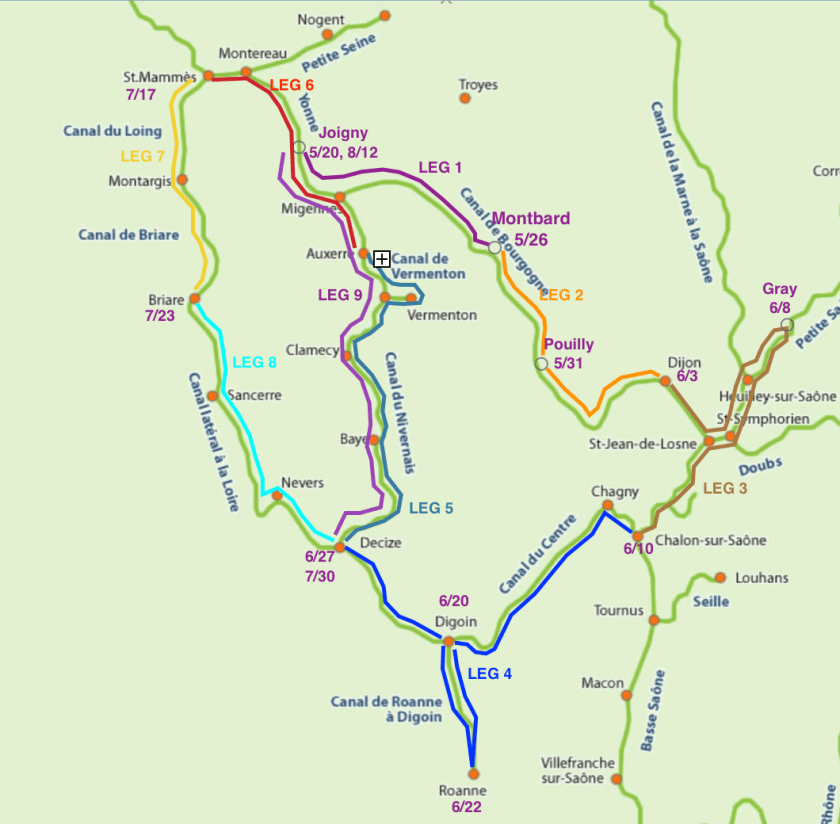
Eastern Loop: Legs 1-5 and part of Leg 6

After just over 7 weeks we have completed the eastern loop of our Burgundian canal adventure.  We left Joigny on May 21 and returned on July 11, traveling 920 kilometers, and traversing 431 locks. We had three sets of visitors and numerous adventures. Some involved bruises. We traversed the entire length of the Canal du Bourgoyne, had a lovely sample of the Saone River, travelled west on the Canal du Centre (doing a side trip down to Roanne) , then north on the Canal du Nivernais and back to Joigny on the Yonne. Thank you to all our visitors… Francis, Emilie, Richard, Jackie, David, Emory, John, Christin.. you all made the adventures more fun!

IMG_5792
View from Locaboat base – May 20
Joigny July 11
View from Locaboat base – July 11

The Locaboat folks have been uniformly helpful and responsive. Our lovely boat, “Bray Sur Somme” has performed flawlessly, with not a single mechanical problem. None of the problems my inner engineer envisioned have come to pass. We have learned that our boat uses about 2L/hr of fuel, that we can go 4-7 days without filling our water tanks, and that we almost never need electricity. Truth be told, we can easily go a week without any outside services. Which suits us just fine. Our favorite moorings are the wild ones, in the river or on the canal, away from the towns. Okay, still within biking distance of a boulangerie, but far from the lights so we can see the Milky Way on moonless nights.

Today we began the western loop of our Burgundian adventure – the smaller of the two. We look forward to another 5 weeks of fun and (mis)adventures. Emerson and Linda join us in a week and we are very excited to have Martini Night people joining us (okay, to be honest,  more crew!).  We plan to reach Sens for Bastille Day (when everything, including the locks, shut down), hoping they will have good fireworks!

Yonne Jul 12
Heading north on the Yonne

Au Revoir, Alaskans

Alaska Flag
Flying the colors!

We arrived in Auxerre yesterday and had to sadly say au revoir to our Alaskan family, John and Christin. They did the entire Canal Du Nivernais  with us (180 Km and 110 locks), in rain and sun, locking up and locking down, through tunnels and cases and cases of wine. We got a personal tour of a 16th century chateau, drove through three tunnels, toured innumerable churches (including the basilica in Vezelay), ate lots of snails,  saw a guy in a restaurant probably die and then come back to life because he hadn’t ordered lunch.

We saw them safely to the Gare Auxerre. The fledgelings have left the nest and are on to Paris for further adventures!

Salade Alaska

But we found something at the supermarché to remember them by.

Vezelay

We arrived in Chapel-Censoir yesterday afternoon and arranged a cab for the 20 Km ride to Vezelay where one walks up “to the imposing basilica perched high above”, which “with its immense Christ in Glory, is one of the greatest Romanesque works of art in the West.” Well, okay.

IMG_7715
Approaching Vezelay
IMG_7714
The Basilique Sante Marie-Madelaine
IMG_7713
The inner entry of the Basilique
IMG_7710
The main part of the church

We arrived just as Vespers were starting so we did not get to see the crypt but we did get to hear some lovely singing. Vezelay is a major stop on the the pilgrimage route (Route of Santiago de Compostela) and we saw several hiker/pilgrims at the service.

At the back of the church, the hill overlooks a broad valley.

IMG_7712
The view from the back of the Basilique
IMG_7711
Two good looking pilgrims

Boat Life

Thought I would do a post about life on the boat. The boat, our home for the past 6 weeks is a ~20 year old Locaboat “Penichette” (little Peniché) called “Bray Sur Somme”. It has a “pullman berth” style double in the front (i.e. only one side has access) and a “wet” head (no separate shower stall).

1165fb

IMG_7246
Forward Berth
IMG_7249
Forward Head

In the back are two sleeping areas, a second pullman berth and two single bunk beds, along with a second head in two separate rooms, a toilet and a sink/shower.

Just back of the forward berth is the galley with a stove/oven (propane), and (sizeable) top-loading refrigerator. Between the galley and he back berth is the main salon with the table and seating and also the inside helm station.

On deck there is a separate helm (the one we almost always use since it is higher and in the center of the boat so easier to use) and a table and seating for eating al fresco (which we almost always do when the weather is nice). We also have a small table and four chairs we take off the boat when the weather and mood suits us.

The boat has a 420L diesel tank and a 700L fresh water tank. We burn about 2L/Hr of diesel which means our range is about 40 days (at 5 hours running a day). This doesn’t translate directly into distance because of the locks.  Water is a lot easier to get which is good because we need it more often. Still, assuming 5-10 gallons/day/person (which is generous), we can easily go 3-4 days with four people.

The boat has a pretty decent heater which runs off diesel with radiators in all the rooms. We have only used it a couple of times (on the rainy and 40 degree days). The boat has no generator or air conditioner so we only have AC power when we are plugged in at a marina (which we do about once a week). We charge our phones off the 12 volt boat battery (there is a car-style 12V receptacle at the helm station).  We always have hot water (the water is heated from the engine and stays hot for at least 24 hours) and is usually so hot you have to be careful with it.

The toilets are electric (pump in water, pump out). Surprisingly they do not use the black water tank on the boat – everything goes overboard. We have little TP garbage cans in each head so only organic material goes overboard. This means swimming in the canal is not attractive but we have swum in the rivers.

The day starts with a walk to a boulangerie (if we are near a town) or, if not, Roberta will whip up a nice omelette. Okay, that was a joke. In six weeks we have made toast, boiled eggs and cooked a piece of salmon for a salad. We usually start motoring at 9 or 9:30 (the locks do not open until 9:00) and motor to lunch (the locks are closed from noon to 1:00). In the afternoon it varies depending on where we are trying to get to but we are usually stopped for the evening by 3:00 or so. Then a walk to town (if are near one) for sightseeing/shopping and dinner if we find a brasserie or restaurant we like.


Rain and Alaskans

Our Alaskan visitors, John and Christin have arrived! We had all kinds of adventures picking them up. We rented a car from a supermarché in Decize which was a little weird. Had a little hiccup getting the car because they required “un justificatif de domicile en FRANCE récent de moins de trois mois” (proof of residence) which, of course, we did not have. They were helpful, though, and suggested a utility bill from our home in Houston which we provided (via email and the internet) which satisfied them.

JC 1
John and Christin (in a brief, non-rain, period)

We ended up with a little manual Clio (no automatics) for a day and a half for 68 Euros which seemed reasonable. We drove to Nevers several hours early to do a little shopping (we have a car!). Strange driving at 90 Km/Hr when, for the past 6 weeks, our top speed has been 8-10 km/hr.

And, just as the French train system seemed to be collapsing (the arrival and departure screen showed all the trains “en retard” by 1 – 2 hours), the train arrived with John and Christin. Drove back to Decize in the rain and prepared to leave for the Canal de Nivernais the following afternoon (Wednesday). The first two days on the Nivernais have been fun but rainy. It rained almost all day today but the day ended with some excitement as we passed through our first multi-locks (ganged locks), the last of which was a triple (three lock cavities and four sets of doors) with a 24 foot ascent.

Christin 2
Our newest helmsman

After suffering through 95 plus days on the Canal de Roanne last week the high today was  in the mid 50’s.